
The audit that couldn't explain itself
The work was right, but nobody could answer when the quality review asked why. On audit documentation, AI and why we are building Revios.
It is a Tuesday in October, and the quality review has picked an engagement from three years ago. Not the hardest one you had that year. A tidy retail company, a clean audit report, no findings.
The reviewer scrolls to inventory and stops at the conclusion. Obsolescence was assessed as immaterial. It is right there in the workpaper, signed and dated. What is not there is how you got to it.
"Who made this assessment, and what was it based on?"
You know the assessment was sound. You even remember the conversation. The problem is that the person who did the work has left. The reasoning is scattered across an email thread with the managing director, a comment in a spreadsheet called something like inventory_final_v4, and a phone call nobody wrote down.
An afternoon of searching
The rest of the day goes into digging. You search the inbox for "inventory" and find the thread. The managing director wrote that the slow-moving stock was sold off in a January sale, and that an overview would follow. You cannot find the overview. In the spreadsheet there is a comment: "OK after call with MD, see email". The email points back to the call.
You phone your former colleague, who now works at another firm. She is helpful and remembers the case well, but not the numbers. She thinks they looked at sales after the balance sheet date. She is almost sure.
By four o'clock you have an explanation that holds together. It is probably right. But it is a reconstruction, not documentation, and both you and the reviewer know it. It becomes a finding. Not a dramatic one, but a finding that never needed to be written.
The work was right. The documentation just didn't tell the story.
The experienced auditor is you
ISA 230 requires documentation good enough for an experienced auditor, with no previous connection to the engagement, to understand what was done, what evidence was obtained and which conclusions were reached. It is easy to picture a stranger doing the review. More often it is you, three years and a few hundred engagements later.
The standard is also specific about something that is easy to forget: significant matters discussed with management should be documented, including when and with whom. The call with the managing director was exactly that kind of matter. It took ten minutes. Writing it down would have taken two.
Why the trail disappears
Many auditors will recognise this, and not because they work carelessly. It is because the work happens in many places at once: in the audit software, in the spreadsheet, in the inbox and on the phone. Each of those places is fine on its own. What happens between them is what disappears first.
Then the busy season arrives. From February to May there are many engagements, tight deadlines and little slack. Documentation becomes something you tidy up afterwards, and afterwards is a busy time. People change teams, leave or go on leave. The person who knew why is no longer the person who gets the question.
None of these things is wrong on its own. Together they mean the audit remembers the conclusion but forgets the way there.
Now AI is in the room
In the last few years, tools have arrived that suggest which transactions to look at more closely, or write a first draft of an assessment. They can save a lot of time, and we use them in Revios too.
Imagine such a tool flags forty transactions around the year end. Your colleague looks at twelve of them and reaches a conclusion. That may well be a sensible choice. But why those twelve? And what about the other twenty-eight? If the answer only exists in the head of the person who did the work, you have the same problem as with the phone call, only bigger.
AI makes the old question sharper. When the reviewer asks who made the assessment, "the system" is not an answer. Was the sample yours or the machine's? Was anything rejected, and why? If you cannot answer that, the time you saved was only borrowed.
Built around one question
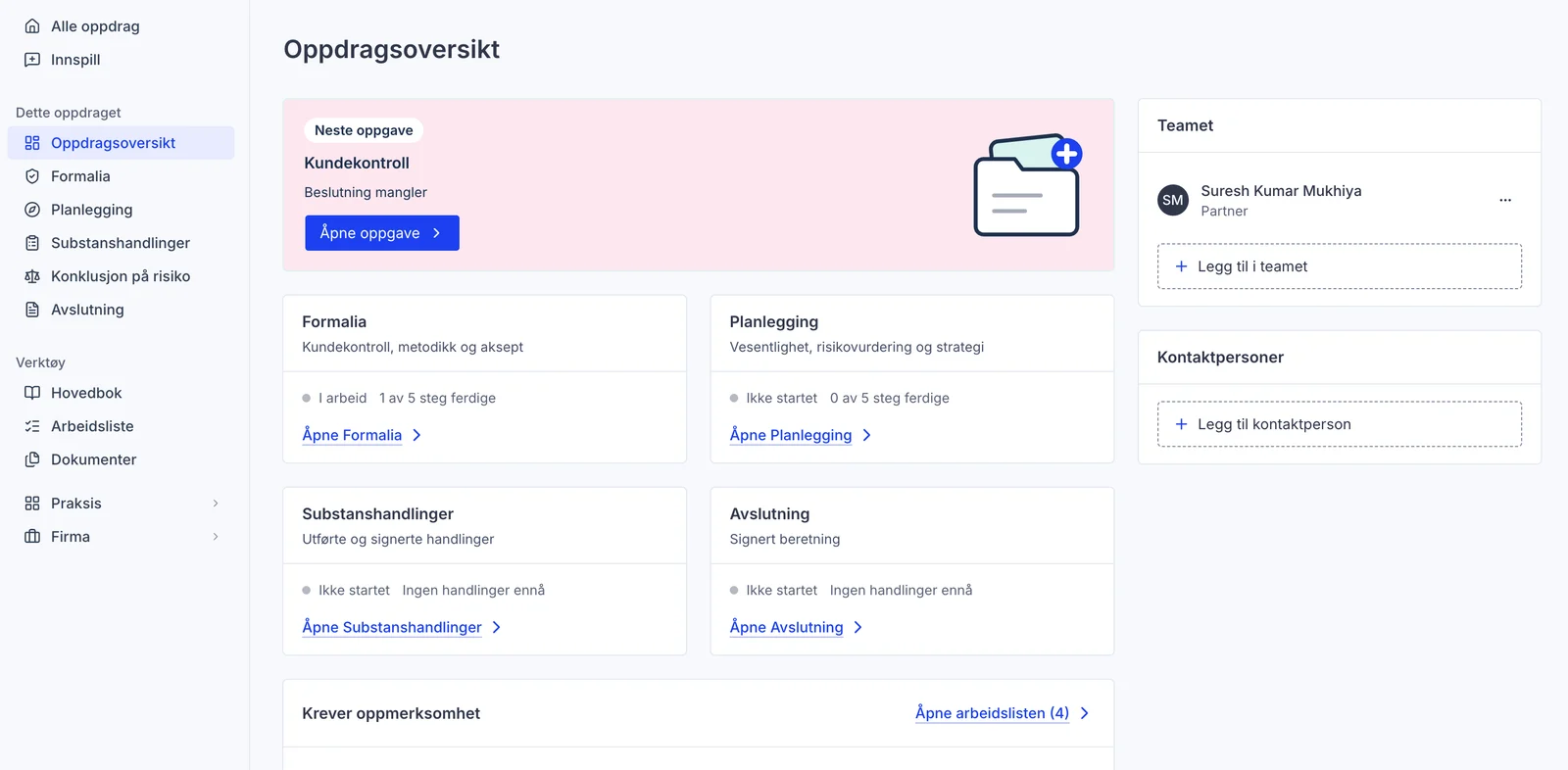
Who decided this, and why? Revios is built so that question has an answer without anyone having to dig for it. In practice that means:
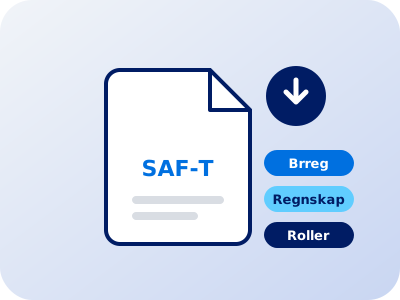
- The whole engagement lives in one place, from organisation number and SAF-T import to the audit report. Assessments, evidence and clarifications are kept on the engagement, not in a folder next to it.
- AI suggestions are marked, stored with their reasoning and have no effect until an auditor approves them. Rejected suggestions are logged too.
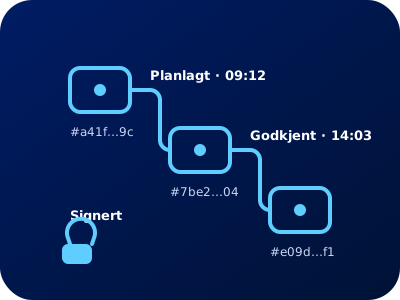
- The audit log is chained and signed. It shows who did what and when, and it cannot be changed afterwards.
- The engagement partner and the quality reviewer approve where the work is, not in an email.
We are not building a robot auditor. Professional judgement belongs to the auditor, and it should stay that way. What we want to get rid of is the searching afterwards.
What you can do tomorrow
Good tools help, but habits matter most. These work whichever software you use:
- Write the reasoning at the same time as the conclusion, while you still remember why.
- When a conversation with management affects an assessment, note who, when and what on the same day.
- Put the evidence where the assessment is, not in your inbox.
- When you decide not to look at something, write down why. It is often the first thing the reviewer asks.
- Pick an old engagement and read it as if you were the reviewer. It teaches you more than a checklist.
Back to that Tuesday
Picture the same review, but with the engagement in Revios. You open inventory and find the obsolescence assessment. You see who made it, which transactions the AI pointed out, which ones your colleague chose to look at more closely, and the note from the call with the managing director. You see that the engagement partner approved the conclusion two days later.
The question gets an answer in a couple of minutes. Nobody has to call a former colleague, and nobody has to be almost sure.
That is really all we are trying to do: make sure the audit can explain itself, even when the person who did it is no longer there.
Want to see what that looks like in practice? We are happy to walk you through an engagement from import to review using sample data. You do not need to send us any client information.
About Revios
Revios is cloud-based audit software for audit firms in the Nordics, delivered by Halifax AS. The whole engagement comes together in one workflow that follows ISA, with AI suggestions the auditor approves, SAF-T import and a signed audit log.